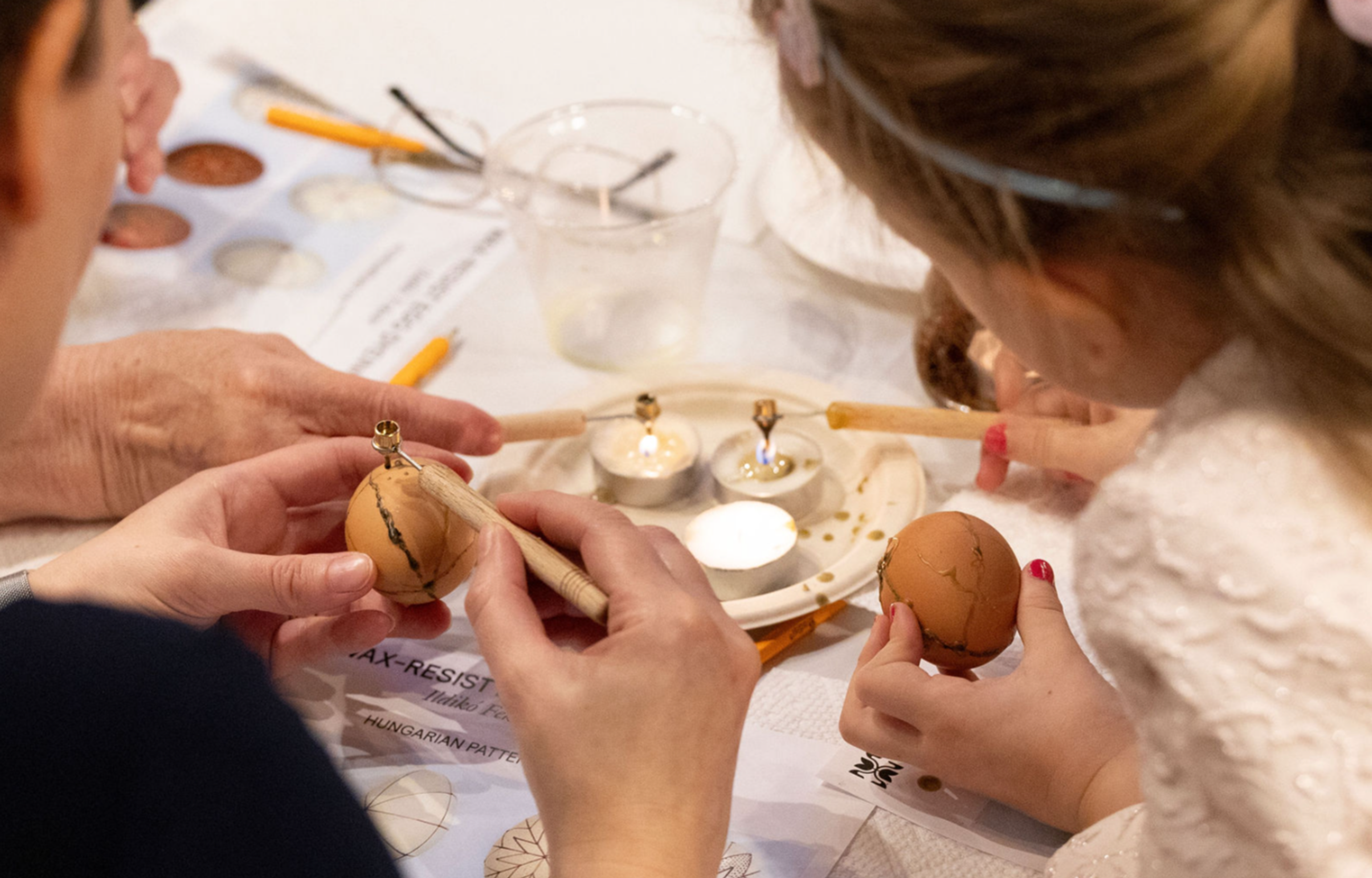
This spring, the Tulipán Foundation brought the art of Eastern European egg decorating to life through a series of sold-out workshops across New York City. Held over three days at MoMath and followed by a larger, community-focused Good Friday workshop at the Hungarian House of New York, the series explored the traditional wax-resist method through both mathematical and cultural perspectives.
At MoMath, the workshops focused on symmetry as a foundation of the artform. Led by Tulipán grantee and award-winning egg decorator Ildikó Fekete, participants looked beyond the surface of decorated eggs to understand the patterns beneath them. Rooted in a 1,500-year-old tradition, designs ranging from stars and flowers to intricate geometric forms are shaped by rotational, reflectional, and translational symmetry.
Just days later, the setting shifted to the Hungarian House of New York, where the focus expanded to the cultural meaning behind the practice. Ildikó Fekete introduced participants to traditional motifs, each reflecting stories of identity, memory, and place passed down through generations, adding another layer to the hands-on experience.
Across all ten sessions, it was amazing to watch how naturally the workshops brought generations together. Family and friends worked side by side, often with two or even three generations gathered around the same table. Regardless of age, each participant could engage at their own level, sharing in the simple joy of the same tradition.
The workshops also welcomed many guests from Eastern and Central European backgrounds, who recognized familiar elements of their own cultural heritage in the patterns and techniques shared. Not just through wax and color, but through the hands that made it and the connections formed along the way.